The Role of IoT in Material Handling Efficiency
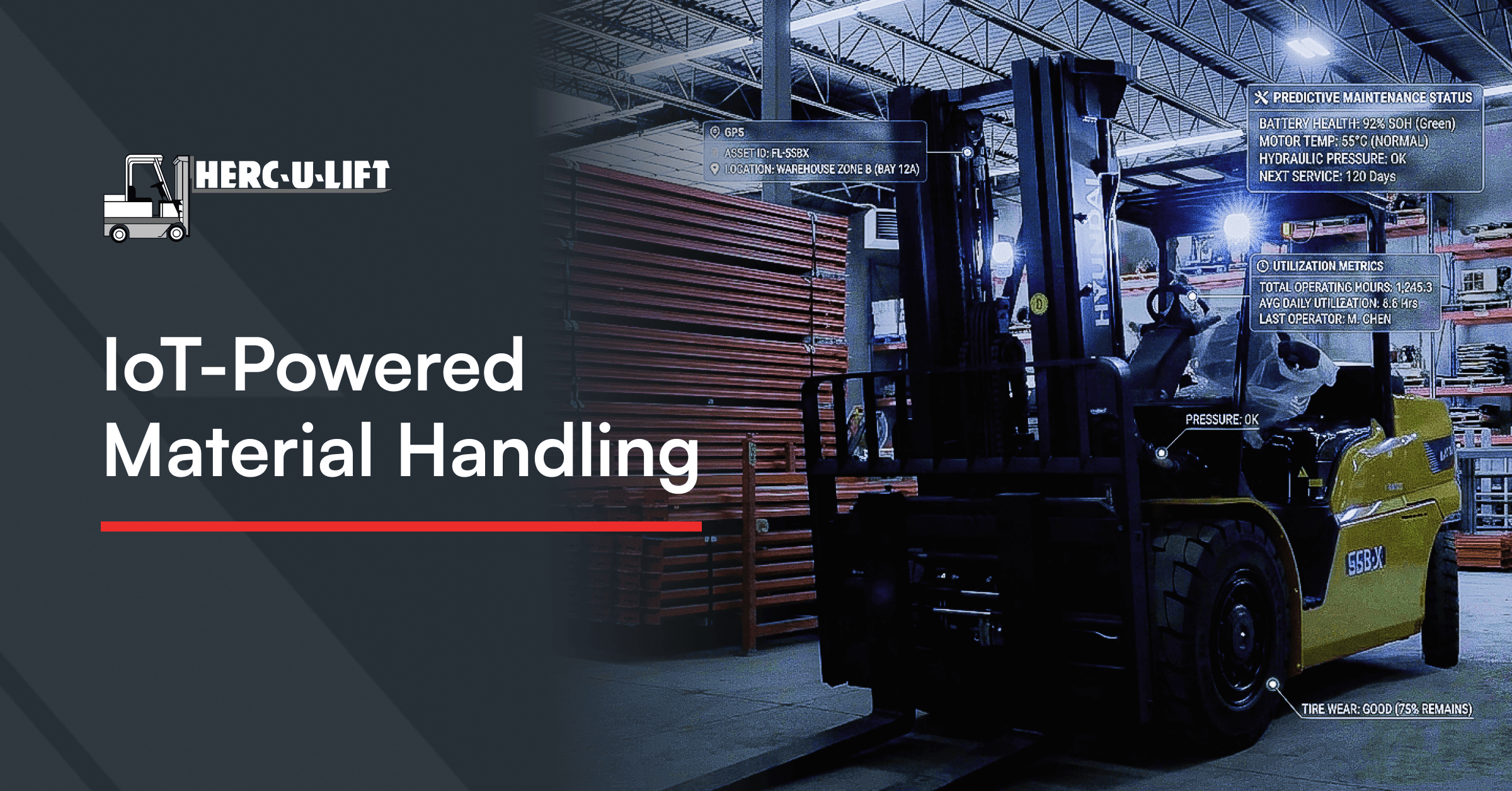
Material handling involves the movement of materials throughout industrial operations. It includes the storage, protection, and control of materials. These activities take place across manufacturing, warehousing, and distribution processes.
Costs rise quickly when material flow becomes inefficient. For example, delays and downtime increase labor expenses. As operations grow, these challenges become harder to manage.
This is where the Internet of Things (IoT) adds value.
IoT connects equipment, sensors, vehicles, and software systems. It provides greater visibility and control across operations.
By delivering real-time data and system-wide coordination, IoT helps improve material handling efficiency. As a result, it reduces downtime and supports better operational decisions.
What IoT Means in Industrial Material Handling
Definition of Industrial IoT (IIoT)
Industrial IoT (IIoT) refers to a network of connected sensors, devices, vehicles, and systems. The technology collects and shares operational data. It allows equipment and software platforms to exchange real-time information across facilities.
Unlike consumer IoT devices designed for convenience, IIoT operates in industrial environments.
In material handling operations, IIoT often integrates with:
• Warehouse Management Systems (WMS)
• Enterprise Resource Planning (ERP) platforms
• Manufacturing Execution Systems (MES)
• Fleet management software
• Automation and control systems
The table below highlights the key differences between consumer IoT and industrial IoT.
Attribute | Consumer IoT | Industrial IoT (IIoT) |
|---|---|---|
Primary Focus | Convenience and automation | Efficiency, reliability, and productivity |
Hardware | Consumer devices for everyday use | Industrial-grade equipment built for demanding environments |
Network Environment | Wi-Fi, Bluetooth, and home networks | Industrial networks designed for reliability and continuous operation |
Data Integration | Connected to consumer apps and platforms | Connected to WMS, ERP, MES, and industrial systems |
Communication | Consumer-focused protocols and cloud services | Industrial communication protocols and control systems |
Downtime Impact | Causes inconvenience for users | Affects operations, productivity, safety, and costs |
Core Components of IoT in Material Handling
Each IoT component plays a specific role:
Sensors collect real-time data from equipment and facility environments. They help monitor equipment usage and operating conditions.
RFID and Barcode Tracking Systems track inventory movement within a facility. They reduce manual tracking. This results in better visibility into material flow.
Telematics in Forklifts and Vehicles capture data on runtime, idle time, battery status, fuel consumption, and operator activity. This supports maintenance planning and equipment utilization analysis.
Wireless Communication Networks allow connected devices to transmit data continuously. This may include Wi-Fi, cellular connectivity, Bluetooth, or industrial communication networks.
Cloud or Edge Computing Platforms process and store operational data. Cloud systems support centralized analytics. Meanwhile, edge computing enables faster processing closer to the equipment for time-sensitive applications.
Analytics Dashboards transform raw data into actionable insights. Managers can monitor equipment uptime and inventory movement.
Together, these technologies create a connected ecosystem. They provide real-time visibility. Of course, the result is better decision-making and greater operational efficiency.
Key Areas Where IoT Improves Efficiency

Quantifying the Efficiency Gains
Integration with Existing Systems
IoT + Warehouse Management Systems (WMS)
IoT improves WMS performance through automated inventory updates and real-time material tracking. This reduces manual data entry and minimizes inventory discrepancies. Warehouse operations also experience better control and visibility.IoT + ERP Systems
When connected to ERP platforms, IoT provides real-time operational data. This supports inventory planning, procurement, production scheduling, and demand forecasting. This helps improve coordination across departments. Ultimately, it supports more informed business decisions.IoT + Automation Systems
IoT also helps connect automation technologies such as autonomous guided vehicles (AGVs), conveyors, robotics, and automated storage systems. Real-time communication improves coordination. As such, it reduces workflow disruptions.Implementation Considerations
Infrastructure Readiness
Successful IoT deployment depends heavily on infrastructure quality.Facilities must evaluate:
• Wireless network coverage
• Data transmission reliability
• Environmental interference
• Edge computing requirements
Large industrial environments often require network upgrades before full-scale deployment.
Cybersecurity Risks
Connected industrial devices introduce cybersecurity concerns.So, planning should be integrated early in implementation. Some potential risks are:
• Unauthorized device access
• Network intrusion
• Operational disruption
• Data theft
Organizations can prevent these risks through:
• Network segmentation between • IT and OT systems • Device authentication • Access controls • Encrypted communications
Data Management Challenges
IoT systems generate large volumes of operational data. Data quality validation and analytics capabilities are essential for converting raw sensor data into operational improvements.Without effective analytics strategies, facilities may experience:
• Data overload
• Poor reporting quality
• Limited actionable insights
Workforce Training
Operational success depends heavily on workforce adoption.Facilities often require training related to:
• Digital dashboards
• Sensor interpretation
• Maintenance analytics
• System troubleshooting
Resistance to monitoring systems may also emerge. This is especially true if employees perceive IoT primarily as performance surveillance rather than operational support.
Common Barriers to Adoption
High Initial Investment
IoT deployments can be expensive for large facilities. Costs increase with equipment scale and system complexity. Many companies also overlook ongoing costs like software licenses and maintenance.
Facilities can consider phased rollouts. They may want to focus on high-impact equipment first. This way, they can prove ROI before scaling further.
Legacy Equipment Limitations
Older forklifts and systems are often not IoT-ready. Some can be retrofitted with sensors. However, results generally vary. Compatibility is not always guaranteed. A practical approach is to prioritize upgrades for critical assets. Retrofit only where full replacement is not feasible.
Integration Complexity
IoT must connect with WMS, ERP, and MES platforms. These systems often use different data formats. Poor integration causes delays or data mismatches.
Using middleware and standardized APIs decreases friction. Working with experienced integration partners further improves reliability.
ROI Uncertainty
Benefits like reduced downtime and better utilization are not always immediate. This makes ROI harder to justify for some. Without benchmarks, IoT can look like a cost.
Facilities can solve this by setting baseline KPIs first. Pilot programs validate gains before full deployment.
Data Overload Without Actionable Insights
IoT generates large volumes of continuous data. Without structure, it becomes overwhelming. Teams may struggle to identify what matters.
Industry-Specific Applications
Manufacturing Plants
IoT monitors real-time movement between stations. Delays trigger immediate adjustments in routing or equipment use. This prevents line stoppages and improves flow consistency.Distribution Centers
Systems assign work based on location and load capacity. Dock scheduling becomes more responsive to current demand. Travel time is decreased. Order velocity is improved.Ports and Intermodal Yards
GPS and UWB systems bring better visibility across large outdoor spaces. This reduces container search delays and double-handling. Equipment coordination becomes more efficient.Mining and Heavy Industry
Sensors track load stress and temperature conditions. This helps prevent equipment failure and safety risks. It also improves fleet distribution across rugged terrain.Decision Framework for Leaders
Leaders can evaluate IoT readiness using this approach:
✓ Identify Critical Cost Drivers
Which material handling variables create the highest operational expenses today? (e.g., unplanned equipment downtime, labor waste, tracking errors).
✓ Locate Operational Blind Spots
What critical performance data is currently missing from your dashboards? (e.g., exact forklift idle times, live component temperatures).
✓ Assess Network Infrastructure
Can your existing wireless network support a high density of connected edge devices across the facility?
✓ Define the Investment Horizon
What are your target payback periods? Also, what are the required internal rate of return (IRR) metrics for digital transformation projects?
✓ Evaluate Cybersecurity Controls
Are your IT and OT networks properly segmented to contain potential security vulnerabilities?
✓ Establish Measurement Benchmarks
Do you have clear baseline metrics to measure post-deployment KPI improvements?
Conclusion
Material handling operations can become more complex over time. In such scenarios, visibility becomes increasingly important.
Organizations that accurately track equipment and inventory are often better positioned to control costs. They respond to operational challenges better.
IoT provides the data foundation needed to support that goal. However, technology alone does not create results. The greatest value comes from using operational data to make more informed operational decisions.
For most facilities, creating a more predictable and efficient operation is a must these days. Achieving that outcome requires a clear strategy and a strong system integration.



 →
→