Narrow Aisle and Articulated Forklifts: Maximizing Warehouse Space and Efficiency
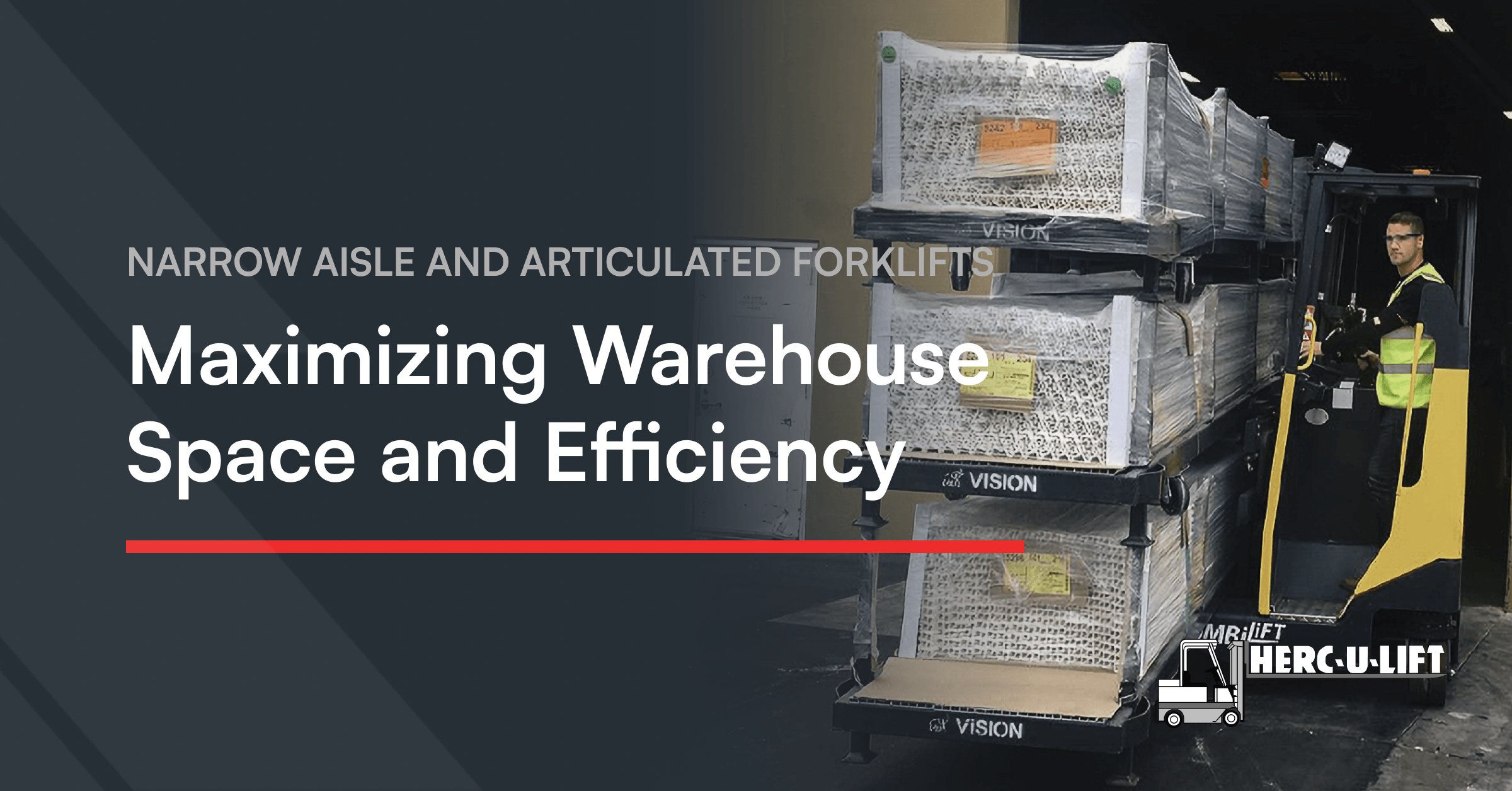
Warehouse space is a valuable asset in most operations.
As inventory levels grow, most facilities eventually ask the same question: “How do we increase storage capacity without undergoing a costly physical expansion?”
For many operators, the answer lies in optimizing aisle widths and material handling equipment.
Narrow aisle forklifts and articulated forklifts are specifically designed to support this goal.
These specialized equipment help improve storage density. Moreover, they delay or eliminate the need for facility expansion. In this guide, we’ll explain how these specialized machines work and how they differ. We also tell you how to choose the right one for your operation.
What Is a Narrow Aisle Forklift?
Definition and Purpose
A narrow aisle forklift is engineered to operate in clear spaces significantly tighter than those required by traditional counterbalance forklifts.
These machines are widely utilized across:
• Distribution centers
• Manufacturing facilities
• Retail warehouses
• Third-party logistics operations
• E-commerce fulfillment centers
With narrow aisle equipment, warehouses can install additional racking rows to maximize their existing footprint.

Typical Narrow Aisle Widths
The table below outlines typical aisle width requirements across primary forklift categories:
Configuration | Typical Aisle Width |
|---|---|
Standard Forklift | 12 to 14 ft |
Narrow Aisle Forklift | 8 to 10 ft |
Very Narrow Aisle Forklift | 5 to 7 ft |
What Is an Articulated Forklift?
How Articulated Forklifts Work
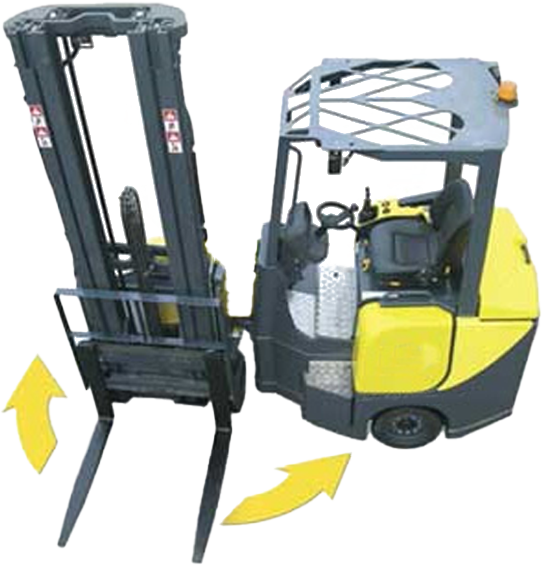
An articulated forklift features a pivoting mast. The front section of the truck rotates independently from the chassis. Instead of making wide turns, the truck can articulate its mast to load or unload pallets while the body remains straight.
The design allows operators to:
• Travel and stack within the same aisle
• Access high rack positions safely
• Operate seamlessly in condensed warehouse layouts
• Minimize turning space requirements
How They Differ from Traditional Forklifts
Traditional forklifts require large turning radiuses and wide aisles to operate. In contrast, articulated forklifts provide:
• Greater maneuverability
• Reduced aisle requirements
• Optimized space utilization
• Better operational flexibility
Industry Note: Combilift is one of the most recognized manufacturers in the industry. The brand specializes in both articulated and multi-directional material handling equipment.
Narrow Aisle vs. Articulated Forklifts
Key Differences
Feature | Narrow Aisle Forklift | Articulated Forklift |
|---|---|---|
Aisle Width Requirement | 8 to 10 ft | 6 to 8 ft |
Turning Radius | Reduced | Very Small |
Trailer Loading Capability | Limited | Often Yes |
Indoor Operation | Excellent | Excellent |
Outdoor Operation | Limited | Often Possible |
Equipment Versatility | Moderate | High |
Storage Density | High | Very High |
Which Is Better for Your Operation?
There is no one-size-fits-all solution. Ultimately, your choice should depend on your:
• Existing infrastructure
• Inventory profile
• Workflows
Narrow aisle forklifts are best for warehouses with consistent pallet sizes and storage lanes. They’re designed for structured environments with predictable movement patterns. This makes them a strong option for high-density storage operations. They help maximize space while keeping inventory access efficient.
Articulated forklifts offer versatility. In fact, they work well in indoor and outdoor environments. They also operate efficiently in facilities with mixed inventory sizes. They’re a strong option for warehouse racking with complex layouts.
What Is a Very Narrow Aisle (VNA) Forklift?
Benefits of Narrow Aisle Forklifts
Best Brands for Narrow Aisle and Articulated Forklifts
Leading Manufacturers
Combilift
Combilift specializes in articulated and multi-directional configurations. They’re ideal for facilities handling standard pallets or long, bulky loads (like timber or steel).Notable models: Combilift Aisle Master, Combilift CB Series, Combilift C-Series
Toyota
Toyota offers a comprehensive line of standard electric warehouse equipment, including reach trucks and order pickers. Their equipment works best in consumer goods distribution centers.Notable models: Toyota Reach Truck, Toyota Order Picker, Toyota Core Electric Reach Truck
Raymond
Raymond developed early innovations in narrow-aisle electric lift trucks. They focus heavily on vertical lift efficiency. Their machines are frequently deployed in deep-reach configurations and micro-fulfillment centers.Notable models: Raymond 7500 Reach-Fork Truck, Raymond Orderpicker
Crown
Crown emphasizes heavy-gauge steel construction and integrated operator control systems. Their lift trucks are suited for high-cycle manufacturing and logistics operations.Notable models: Crown ESR Series, Crown TSP Series, Crown SP Series
Jungheinrich
Jungheinrich specializes in lithium-ion battery integration and automated guided vehicle (AGV) systems. Their machines are used in high-density, automated environments.Notable models: Jungheinrich ETV Series, Jungheinrich EKX Series, and Jungheinrich EKS Series
Hyster
Hyster builds high-capacity narrow aisle trucks designed for rigorous material handling. The brand is often spotted in industrial settings where narrow-aisle storage overlaps with non-standard pallet weights.Notable models: Hyster N30-45ZR, Hyster C1.0-1.5, Hyster LO Series
Why Many Warehouses Choose Combilift
Combilift forklifts operate efficiently in tight aisle configurations. Their machines become a practical solution for operations looking to improve space utilization and overall productivity.
The brand is also known for its multi-directional capabilities. This simplifies the handling of long loads, such as lumber, pipe, and steel. Many models can operate both indoors and outdoors. In most cases, warehouses only need a single piece of equipment to support loading and storage activities. This versatility streamlines operations and improves efficiency.

Applications for Narrow Aisle Forklifts
Warehousing and Distribution
These environments prioritize storage optimization and fast inventory access. Narrow aisle equipment allows facilities to increase pallet positions within the same space while maintaining efficient picking and movement.Manufacturing Facilities
Manufacturers rely on narrow aisle solutions to support both raw materials and finished goods storage. This helps maintain smooth production flow and reduces congestion around production lines.Building Materials Operations
Operations that handle bulky materials benefit from the maneuverability of articulated forklifts. These machines safely transport items (lumber, pipe, steel, and panels) in tighter spaces where traditional forklifts may struggle.Retail Distribution Centers
These environments prioritize storage optimization and fast inventory access. Narrow aisle equipment allows facilities to increase pallet positions within the same space while maintaining efficient picking and movement.Third-Party Logistics (3PL) Providers Facilities
Third-party logistics facilities usually operate within fixed warehouse footprints and tight margins. Narrow aisle and articulated equipment help increase storage capacity and improve throughput.How to Determine if a Narrow Aisle Solution Is Right for You
Questions to Consider
Before investing in a solution, it’s important to assess your current operation and future growth plans.
Consider the following questions:
Are you running out of storage space? Limited storage capacity is often the first sign that a warehouse is reaching its layout limits. Inventory growth puts pressure on workflow efficiency. In many cases, optimizing the existing facility is more practical than costly building expansion.
Are expansion costs becoming difficult to justify? Building additions, facility relocations, and warehouse expansions require significant capital investment. Increasing storage density within the existing square footage delivers a more cost-effective solution.
Do you need more pallet positions? Additional pallet positions allow facilities to store more inventory without increasing building size. This can support growth while improving inventory organization and accessibility.
Are current aisle widths limiting efficiency? Wide aisles consume valuable floor space that could otherwise be used for storage. Reducing aisle widths with the right equipment can increase capacity while maintaining efficient material flow.
Do you need equipment that can operate both indoors and outdoors? Some operations require item movement between warehouses, loading docks, yards, and delivery areas. Equipment that can handle multiple environments may improve flexibility and reduce the need for additional machines.
Warehouse Assessment Factors
A simple assessment helps ensure the equipment matches your layout, workflow, and long-term storage goals.
Rack Layout
If your current layout uses wide aisles, there may be opportunities to reconfigure racking and increase pallet positions. The goal is to determine whether aisle widths can be safely reduced without disrupting traffic flow.Ceiling Height
Evaluating ceiling clearance determines how much additional vertical storage can be added. For example, higher racking systems combined with the right lifting equipment allows you to increase storage density.Inventory Turnover
High-turnover operations benefit from faster access and tighter picking efficiency. Meanwhile, lower-turnover inventory may prioritize storage density.Product Dimensions
Load size and shape directly influence handling requirements. Oversized or fragile goods may require specialized forklift attachments.Operator Training
Different forklift types require different certifications. More advanced equipment (such as articulated or very narrow aisle systems) may necessitate additional operator training to ensure safe operations.Frequently Asked Questions
With that, VNA systems can delay costly building expansions or relocations. For high-volume operations, that can provide significant long-term value.
Conclusion
Let’s face it: warehouse square footage is expensive. Maximizing every square foot has become a major priority for many operations.
Narrow aisle and articulated forklifts are made for space-efficient operations. They increase storage density while supporting smooth, reliable workflows.
The ideal solution varies from one facility to another. Factors such as layout, inventory, and throughput deserve careful consideration.
In any case, upgrading your equipment is a quick way for space-constrained operations to scale their capacity.



 →
→