Choosing the Right Forklift for High-Density Warehousing
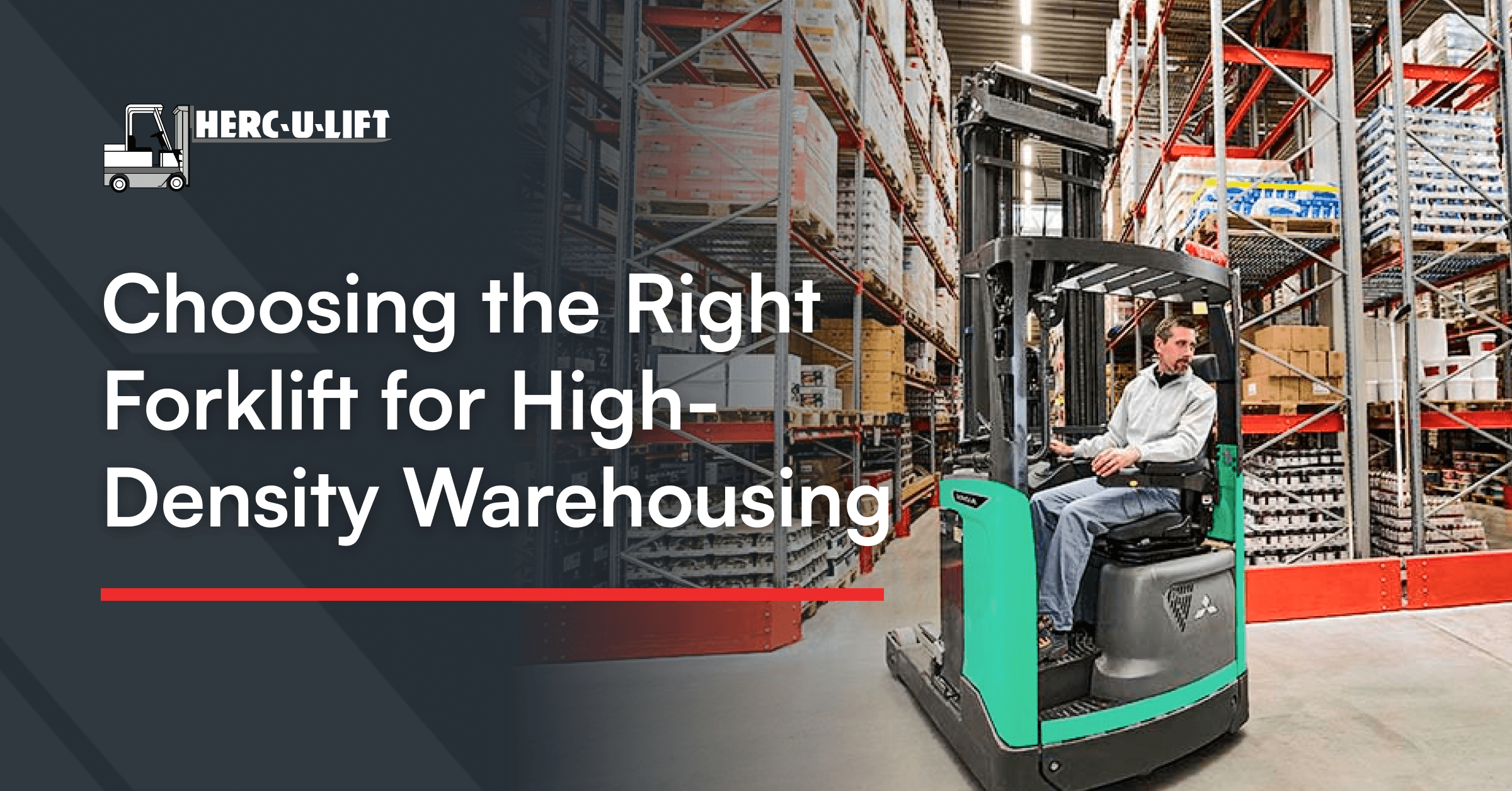
Many warehouse operators assume that adding more racking is the answer to storage space problems.
While additional storage systems can help, the equipment moving through those aisles often has a much greater impact on warehouse efficiency.
Case in point, the wrong forklift can limit storage capacity and create traffic congestion. It also leads to slower order fulfillment and increased operating costs.
Forklift selection is then not just about lift capacity or purchase price. Warehouse layout, storage density, inventory flow, and operator productivity all influence which equipment delivers the best long-term results.
This is particularly true when evaluating reach trucks and stand-up forklifts. While both are common in modern facilities, they solve different operational challenges. Choosing the right configuration improves storage utilization and delays costly structural expansions.
Why Warehouse Layout Matters More Than Forklift Horsepower
When evaluating forklifts, buyers initially focus on lift capacity or travel speed. While these features matter, they do not determine overall performance.
Warehouse layout has a much greater influence on efficiency.
Several factors directly affect forklift selection:
How Material Moves Through High-Density Warehouses
Every stage of warehouse operations creates different material handling requirements. Understanding material flow helps determine where reach trucks and stand-up forklifts deliver the greatest operational value.
| Receiving → Put-away → Storage → Picking → Replenishment → Shipping |
Expert Note: The most productive warehouses often use multiple equipment types. Rather than relying on a single model, they align equipment capabilities with specific operational requirements.
Understanding Reach Trucks
A reach truck is a highly specialized piece of narrow aisle equipment. It is engineered specifically for high-elevation pallet placement within racking systems.
Unlike standard forklifts, it doesn’t rely on a heavy external counterweight extending behind the chassis to balance the load. Instead, it utilizes outrigger base legs to distribute the weight of the payload directly underneath the mast structure.
This design provides several operational advantages:
Understanding Stand-Up Forklifts
A stand-up forklift, often referred to as an upright forklift or standing forklift, bridges the gap between conventional counterbalance models and high-reach narrow aisle units. It retains a traditional mast configuration (the forks do not extend forward on a pantograph) but features an open, standing operator compartment.
Reach Truck vs Stand-Up Forklift
While both machines are commonly used in warehouse operations, they are designed for different tasks. The following comparison highlights the key differences between each machine:
Performance Metric | Reach Truck | Stand-Up Forklift |
Primary Design Focus | High-density storage and high-level stacking in narrow aisles | Fast pallet movement, cross-docking, and general warehouse transport |
Typical Aisle Width | 8.5 to 9.5 feet | 10 to 11 feet |
Maximum Lift Height | Up to 45+ feet | Typically up to 20 to 25 feet |
Forks Mechanism | Pantograph reach mechanism extends forks forward | Fixed mast with forks moving vertically |
Dock & Trailer Suitability | Limited suitability for frequent dock work | Well-suited for dock and trailer operations |
Turning Radius | Extremely tight maneuverability in narrow aisles | Compact design for efficient warehouse travel |
Optimal Travel Distance | Short to medium distances within storage aisles | Medium to long distances across warehouse floors |
Operator Environment | Focused on high-level visibility and precision placement | Designed for frequent entry and exit with excellent travel visibility |
Best Warehouse Application | Narrow aisle storage and retrieval | Shipping, receiving, staging, and pallet transport |
Storage Density Capability | Excellent | Moderate |
Deep Dive Comparisons:
Lift Height and Pallet Retrieval
The reach truck dominates vertical performance. If your storage configuration requires lifting a 3,000-pound pallet to a 35-foot beam level, a high reach forklift is a must.A stand-up forklift loses substantial residual capacity at those heights. Besides, the entire weight must be counterbalanced by the chassis body, rather than supported directly beneath the load by outriggers.
Aisle Width and Turning Radius
The reach truck operates inside a tighter spatial envelope. Because it cradles the load within its own wheelbase during transit, it can make right-angle turns into racks within a sub-10-foot aisle.A stand-up unit requires a slightly wider aisle. The load rests completely in front of the front wheels. The turning arc must account for both the length of the load and the rear counterweight swing.
Dock Work and Versatility
The stand-up model wins on versatility.A reach truck’s outrigger wheels are small, solid polyurethane disks designed for pristine, smooth concrete floors. Driving a reach truck over a bumpy loading dock plate or into the ribbed interior of a shipping trailer causes severe tire flat-spotting and structural jarring.
The stand-up model handles dock-to-stock workflows seamlessly.
When Double Deep Reach Trucks Make Sense
As warehouses attempt to maximize storage capacity, many explore double-deep racking systems. A double deep forklift is a specialized reach truck designed to access pallets stored two positions deep within the rack structure.
Increased Storage Density
Double-deep storage increases pallet positions. By reducing the number of aisles required, facilities can dedicate more space to inventory.A double deep reach truck can access pallets stored in the second rack position. This allows warehouses to take full advantage of higher-density storage layouts.
Inventory Considerations
Double-deep storage works best when inventory characteristics support the storage strategy. Products with lower turnover rates often fit well within double-deep configurations.A double deep reach truck is most effective when handling products that remain in storage for longer periods. Of course, proper inventory planning helps maximize the benefits of the system.
Retrieval Trade-Offs
Higher density storage typically creates certain operational trade-offs. Retrieving pallets stored in the rear position may require additional handling compared to single-deep systems.Because a double deep reach truck can reach beyond the front pallet position, it minimizes the need for additional equipment.
Warehouse Problems These Forklifts Solve
Warehouses experience operational challenges that cannot be solved simply by adding labor or expanding inventory space. Selecting the right equipment can help address many of these issues.
Choosing Equipment Based on Warehouse Design
Operator Productivity and Ergonomics
Maintenance and Lifecycle Considerations
Battery Maintenance
Some warehouses prefer electric forklifts. Traditional lead-acid batteries require regular watering, periodic equalization charging, and proper charging practices to maintain performance.Many operations are now adopting lithium-ion battery technology. These systems allow opportunity charging during breaks without affecting battery health.
Mast Inspection
High reach forklifts subject their masts to intense structural stress during deep extension runs. Lift chains and lift cables must be inspected weekly for uneven stretching, micro-cracks, or dry links. Wear pads within the mast channels also must be checked and replaced periodically.Wheel Wear
Reach trucks rely on low-profile polyurethane load wheels on their outriggers. These wheels are highly susceptible to damage from running over floor debris. If debris wraps around the axle, it locks the wheel and creates flat spots.Hydraulics System Upkeep
Hydraulic systems support lifting and positioning functions. Leaks, contamination, and component wear affect productivity, if left unaddressed.Planned Maintenance
Preventive maintenance helps reduce unexpected downtime. Structured service programs often improve long-term equipment reliability.Parts Availability
Access to replacement parts can influence repair timelines. Organizations should consider long-term parts support when evaluating equipment fleets.Warehouse Safety in Narrow Aisles
Operating heavy machinery inside compact space envelopes presents distinct safety challenges.
Pedestrian Safety
Clear traffic management practices reduce interactions between pedestrians and equipment. Proper training and facility design are essential.Rack Clearance
Tighter aisle configurations leave less room for error. Operators must maintain proper positioning to avoid rack damage.Lift Height
As lift heights increase, precision becomes more important. Operator training and equipment maintenance help support safe operation.Load Stability
Loads must remain stable throughout lifting, travel, and placement activities. Equipment should always be operated within manufacturer specifications.Operator Certification
Qualified operators are essential for warehouse safety. Training ensures equipment is used correctly and consistently.Line-of-Sight and Visibility
Good visibility helps operators identify hazards and navigate safely. Warehouse design should support clear sight lines whenever possible.Future Trends in Warehouse Lift Equipment
Several emerging trends are influencing equipment selection and fleet management strategies.
Lithium-Ion Batteries
Lithium-ion battery technology continues to gain popularity. Benefits often include reduced maintenance and faster charging.Telematics
Telematics systems provide visibility into equipment utilization, maintenance needs, and operator behavior. These insights support data-driven decision making.Fleet Management
Modern fleet management systems allow organizations to optimize equipment deployment. In addition, it helps reduce unnecessary costs.Semi-Autonomous Forklifts
Automation technologies continue to advance. Semi-autonomous systems support repetitive material handling tasks while improving consistency.Warehouse Automation
Many facilities are incorporating automation into broader warehouse strategies. Forklift fleets increasingly operate alongside automated systems and warehouse management software.AI-Assisted Fleet Optimization
Artificial intelligence is beginning to influence fleet management decisions. Predictive maintenance, equipment utilization analysis, and workflow optimization are becoming increasingly common.Frequently Asked Questions
Requirements vary by model and application. However, reach trucks generally operate in narrower aisles than traditional counterbalance forklifts.
Final Thoughts
Warehouse efficiency is rarely determined by forklift capacity alone.
The relationship between warehouse layout, inventory strategy, workflow design, and equipment selection has a much greater impact on long-term performance.
Reach trucks help organizations maximize vertical storage and improve pallet density within narrow aisles. Stand-up forklifts support fast-paced warehouse environments where maneuverability and frequent operator movement are priorities.
The most effective facilities evaluate equipment as part of a broader optimization strategy. Rather than focusing solely on the forklift itself, they consider how the equipment supports storage capacity, productivity, safety, and future growth.
When selected strategically, a reach truck, warehouse reach truck, high reach forklift, stand-up forklift, or double deep forklift becomes more than a material handling asset. It becomes a tool for improving overall warehouse performance and supporting long-term operational success.



 →
→